
AdGuard launches Manifest V3 compatible ad-blocker for Chrome – Ghacks

AdGuard, the company best known for its content blocking solution, launched what it calls the “world’s first ad blocker built on Manifest V3”.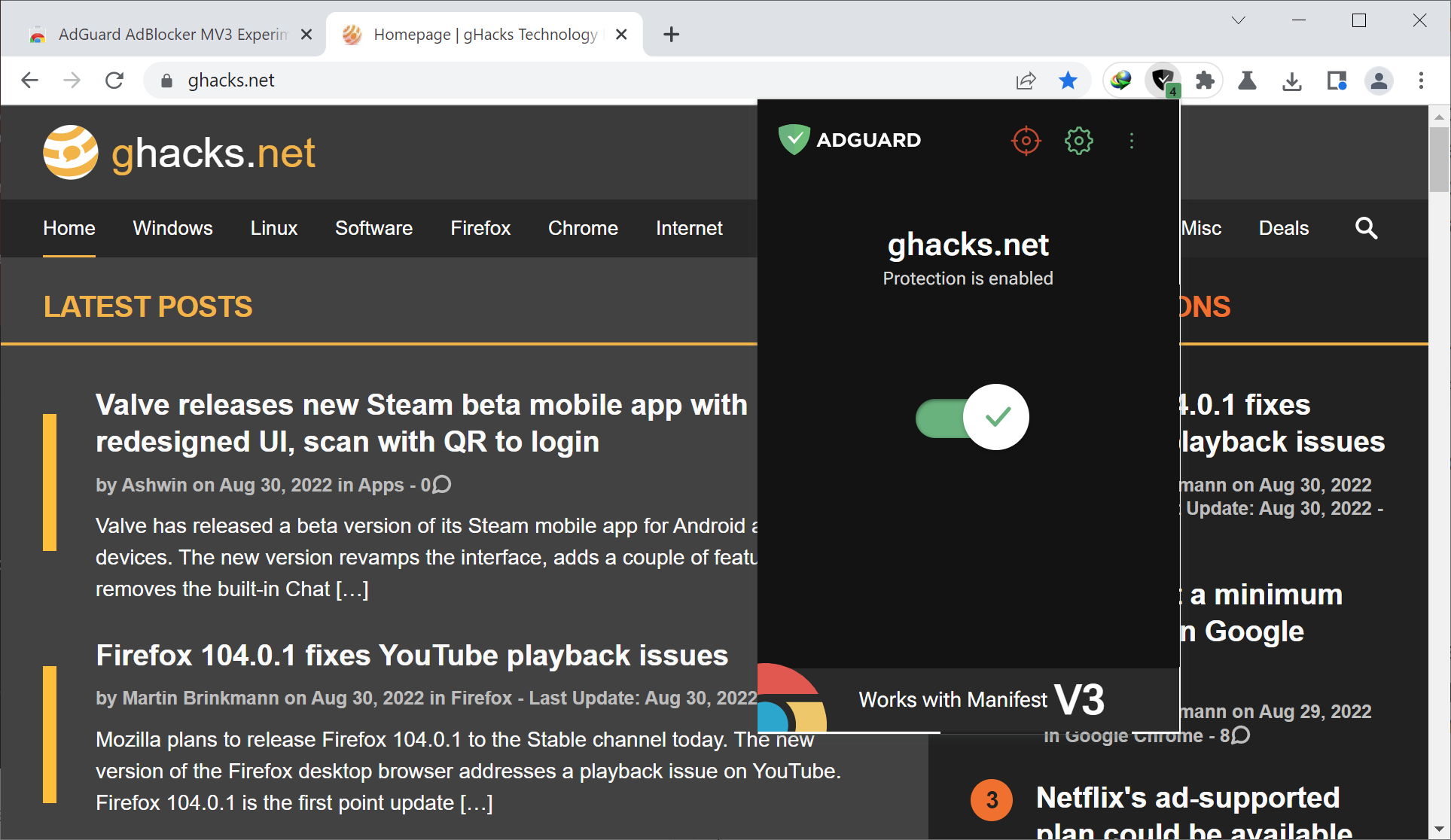
Chrome and Chromium-based browser users who have not followed the news regarding the future of extensions in the browsers, may need a quick explanation to better understand what is going to happen in the coming months and years.
Google announced plans to release a new Manifest for extensions in 2018. Manifest V3 defines what extensions can and can’t do in the Chrome web browser, and any other browser that implements it. Extension developers, privacy advocates and users criticized Manifest V3 shortly thereafter. The developer of uBlock Origin, who maintains one of the most respected content blockers, said that the release of Manifest V3 could mean the end uBlock Origin for Chrome.
Some browser makers, including Mozilla, maker of Firefox, stated openly that they would not implement the limiting changes of Manifest V3. Google made some concessions, but went ahead with the launching of Manifest V3 in the company’s Chrome web browser.
Starting in January 2023, extension developers may no longer publish new Manifest V2 extensions or update existing ones. From June 2023 onward, Manifest V2 extensions won’t run in Chrome anymore.
In other words: extension developers need to update their extensions to be compatible with the new Manifest V3 or end development for Chrome. Some Chromium-based browsers may modify the default behavior to support Manifest V2 extensions, but most won’t, probably.
AdGuard published a new browser extension for Chrome and other Chromium-based browsers that is based on Manifest V3. Users of AdGuard do not need the extension, as the main solution runs system-wide.
Work on the extension started in mid-2021. The developers note that the new APIs of Manifest V3 caused a lot of headache during development. While they managed to produce a working content blocker based on Manifest V3, they concede that it has certain limitations that Manifest V2 content blockers did not have.
One of the main issues of Manifest V3 is that it imposes a fixed limit of 330,000 rules for all extensions installed in Chrome. Any one extension has guaranteed access to 30,000 rules. The number may sound like much, but when you realize that modern content blockers rely on tens of thousands of even hundred thousands of rules, the limitation becomes apparent right away.
Take uBlock Origin as an example. The default configuration of uBlock Origin uses 80435 network filters and 45243 cosmetic filters; that is already more than four times the minimum guaranteed rules limit. Users may add their own custom rules to many content blockers or subscribe to more rules listings. It is easy to reach the 330,000 rules limit with just one extension.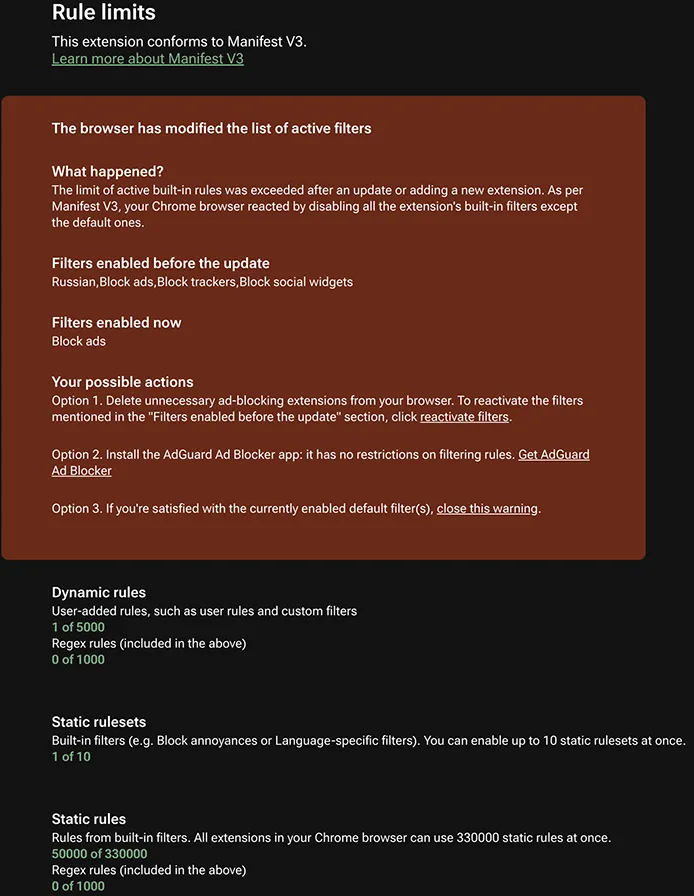
Now imagine that other extensions are installed that rely on rules. These compete with each other then when it comes to the limits.
Dynamic rules have an even stricter limit of 5000, which includes a limit of 1000 regular expression rules. When the limit is exceeded, only the first 5000 rules will be applied by the content blocker, while all other rules have no effect.
AdGuard MV3 Browser takes that into account. The developers have added warnings to the extension that inform users when the rules limitation is forcing the extension to reduce the number of rules that it supports. In fact, the developers note that even the basic filter lists, which is the primary list of AdGuard, may be disabled in the worst case, as it has more than 30,000 rules. For users, it can mean that the installed content blocker does nothing at all.
Closing Words
AdGuard’s new browser extension for Chrome demonstrates that content blockers are possible under Manifest V3. Compared to Manifest V2 content blockers, Manifest V3 extensions can be less powerful due to the artificial rules limits of Manifest V3. Especially the competing part is troublesome, as extensions may stop working if rules limits are reached.
Most Chrome users may want to switch to another browser when Manifest V3 becomes the standard to get a reliable protection and not a chaotic one.
Now You: are you affected by Manifest V3?
Am I affected? HELL NO.
Chrome will continue to have ad blockers, for the people that want them. Google IS NOT prohibiting ad blockers, it welcomes them with open arms.
Only Firefox fans have spread this misinformation, hoping their failing browser and dwindling userbase receives an influx of new users (dream on).
That is not the only misinformation they have spread, ‘Google Chrome is a monopoly’. They don’t know what the definition of monopoly is, haha. They like to shift goalposts saying ‘Google Chrome has a engine monopoly’. No such thing, and you will be laughed out of court.
Who’s the conspiracy theorists? You are.
Am I affected by Manifest V3? Definitely not, given I do not use any Chromium browser even if, to quote the article, “Some Chromium-based browsers may modify the default behavior to support Manifest V2 extensions, but most won’t, probably.
I’m running Firefox, I’m running uBlock Origin for Firefox, I don’t have to face Google’s Manifest V3.
Is Google Chrome a monopoly? If you search for ‘Google Chrome monopoly’ you’ll find many, many answers, one of which states that Google, the company, looks more like an oligopoly (whilst Google, the search engine, inherently a simple monopoly) : [https://fourweekmba.com/is-google-a-monopoly/]
But, after all, no one forces anyone to use Google and its various “services”. Of course may be mentioned some Google practices and above all Google brainwashing which manages to hold such strong market shares. All GAFAM companies do as well, i.e. Microsoft and its unethical behavior to push users to upgrade to Windows 10 : remember?
I’ll stick to my belief, shared by many users, that GAFAM companies are the worst which ever happened to the Web, with a nevertheless lesser anger concerning Microsoft : they started it all, it’s only after that the company failed to be respected.
There’s a new generation of users who understand what the Web is nowadays and provide talented developers to find alternatives to practically all Web services which are managed with one main policy : market share, whatever it takes to achieve that.
So its up to each of us to choose : either follow the leaders, be tracked, be used… or adopt the new enlightened generation which strives for a free Web, but free in terms of your privacy before all.
“ Google IS NOT prohibiting ad blockers, it welcomes them with open arms.”
Google is an advertising company, are you sure they like ad blockers so much?
@ChromeFan
> Google IS NOT prohibiting ad blockers, it welcomes them with open arms.
Nah, come on. Google hates adblockers, but they can’t do away with them entirely, as the user hemorrhage would be massive if they did (obnoxious ads on YouTube alone would make sure of this). So they go with crippling them, so while they technically still allow adblockers, in reality they reduce their effectiveness via insufficient upper rule limits.
From a security perspective, users should be supportive of the Manifest V3 changes. The webRequest API uBO dev @gorhill is so fond of allowed extensions to directly intercept the connections the browser establishes, and to manipulate them. uBlock Origin used these capabilities for good, but do you know who else used them? A large swath of the malware and spyware extensions installable on Chromium! The webRequest API is optimal for spying on users and for redirecting them to malicious websites. If you keep it, you are basically shitting on very basic security concepts and you indicate that you don’t care about malware. Mozilla chose to keep it in Firefox, which is questionable.
The new declarativeNetRequest API is an improvement insofar as extensions now “hand” their rules to the browser itself which then does the blocking according to those rules. This will eradicate spyware extensions! The asshole move of Google was to limit the total numer of rules that can be applied though; this really was done to cripple adblockers and not much else. Actually, the declarativeNetRequest API with no rule limit would be the optimal solution…
Now, I don’t think this issue is as big as the Firefox community wants it to be (for obvious reasons that you pointed out). No native adblocker will be affected because those do not use extension APIs at all, so the native adblockers of Brave, Vivaldi, Bromite etc. will continue to work. I use Brave and I don’t an extension to do the adblocking for me. Not to mention that all systemwide adblockers like Blokada, AdGuard Desktop or network-wide adblockers like Pi-Hole are still available too.
I don’t know what the Firefox community thinks will come out of this for them. Those that never had an adblocker still won’t care, those that use one will still have a limited one and will probably not even notice a difference, and those that need a potent adblocker still have other options like Brave because Firefox needs to come into play(!?). Chrome on Android never supported ANY extension to begin with, and how did Firefox do on Android? If anything, this will help Brave since it is known as the adblock browser basically. I think this is not a good change for Chrome users, but that the migration that FF promoters and fans hope for also certainly won’t happen. Just my two cents.
*before Firefox needs to come into play
My home is protected by pi-hole.
My android devices are also protected by Blokada.
My router provides pfBlockerNG as an automatic failover if pi-hole drops temporarily.
I don’t use Chrome, anyway.
Personally I don’t use Chrome. Google does too many dumb things with their products that annoy me, and they constantly make dumb decisions (like M3). Firefox runs much better than Chrome does (though Chrome handles scrolling better).
That said, network protection switched from extension-based protection to multi-pronged protection a while ago. uBo, as great as it is, never should be your only protection.
Use Pihole or Adguard Home, Next DNS, ControlD, or the new Adguard DNS, and a dedicated firewall that can block direct IP connections for those apps (Google) that will try to skip DNS and go directly to their pre-configured IP address.
Google can’t prevent us from blocking connections, try as it may.
“…In fact, the developers note that even the basic filter lists, which is the primary list of AdGuard, may be disabled in the worst case, as it has more than 30,000 rules. For users, it can mean that the installed content blocker does nothing at all.”
What a PITA the changes Google have made with Manifest V3 is.
It would be better to ditch Chrome and Edge altogether and use Brave or Vivaldi. As these have blocking capabilities built directly into the browsers, they are unaffected by the Manifest V3 changes. And as they don’t rely on third-party extensions (and the dangers that can also bring) they are a more robust solution anyway.
I’m not sure what companies will do though, they have a bit of a dilemma:
If they use Chrome or Edge, the blocking capabilities are going to be limited and their users may end up clicking on malicious ads that are not blocked. In addition, if the uBlock Origin developer follows through with no longer supporting Chromium browsers once Manifest V2 is removed, then they are no longer going to be able to manage the content blocker via Group Policy like they currently can with uBlock Origin.
I can’t see them adopting Firefox, as we live in a Chromium/Safari world now and companies are not going to want to deal with support calls when websites don’t work properly. Also, their own internal systems are mostly only tested against Chrome and Safari due to too low market share of Firefox.
I also can’t see them adopting Brave due to all the crypto crap. It’s also not possible to control Brave Shields using Group Policy like you can with uBlock Origin.
And DNS level blocking or operating system level blocking don’t have the same capabilities as browser level blocking.
One thing I don’t understand is why this affects Chromium, and Chrome, both. But then I didn’t understand why Google forced FLoC and now Topics on everyone. Isn’t it monopolistic to force Microsoft, Vivaldi, Brave, etc. to use their ad revenue platforms to enrich Google?
Though depending on how Manifest V3 affects Bromite, I may permanently switch to a Firefox Variant on Android.
@Coriy
The change is implemented in Chromium, of which Chrome is technically a closed source fork. Other forks include Edge, Brave, Opera, Vivaldi etc. Forks receive the change when they merge new upstream code into their downstream fork.
As for why it‘s not monopolistic: The Chromium open source code is provided as is, nobody is forced to use it. If other companies use it and disagree with changes, they can disable them or patch them out. By the way, not even all Chromium-based browsers together would be a monopoly, because Safari and Firefox exist.
Nothing new here, just google going out of their way to make seemingly subtle changes to the detriment of its users.
Whoever thinks feels that Google welcomes adblockers with open arms is sadly delusional. If you cannot concede that is a fact on the desktop platform then you just have to look towards the mobile platform for your answers as many adblockers and many other apps are banned on the google play store and google makes people jump through hoops to install such addons outside of the google play store to push your basic people out of seeking elevated rights to make the correct changes to claim some rights back.
I will do you better. I commented with some detail instructions including tools, apps, tweaks, etc on a popular channels video regarding android and ungoogling yourself and my comment was blocked and deleted by youtube and not the channel itself.
Let’s no kid ourselves here, google are out for themselves and their partners.
chromefan:
shut up.
enough said.
Please click on the following link to open the newsletter signup page: Ghacks Newsletter Sign up
Ghacks is a technology news blog that was founded in 2005 by Martin Brinkmann. It has since then become one of the most popular tech news sites on the Internet with five authors and regular contributions from freelance writers.