
Computer Chips That Imitate the Brain – SciTechDaily

By
The new technology could allow computers to do complicated tasks more quickly and accurately while using much less energy.
A new microelectronics device can program and reprogram computer hardware on demand by using electrical pulses
What if a computer could learn to rewire its circuits based on the information it receives?
A multi-institutional collaboration, which includes the U.S. Department of Energy’s (DOE) Argonne National Laboratory, has created a material that can be used to create computer chips that can do just that. It achieves this by using so-called “neuromorphic” circuitry and computer architecture to replicate brain functions. Purdue University professor Shriram Ramanathan led the team.
“Human brains can actually change as a result of learning new things,” said Subramanian Sankaranarayanan, a paper co-author with a joint appointment at Argonne and the University of Illinois Chicago. “We have now created a device for machines to reconfigure their circuits in a brain-like way.”
With this capability, artificial intelligence-based computers might do difficult jobs more quickly and accurately while using a lot less energy. One example is analyzing complicated medical images. Autonomous cars and robots in space that might rewire their circuits depending on experience are a more futuristic example.
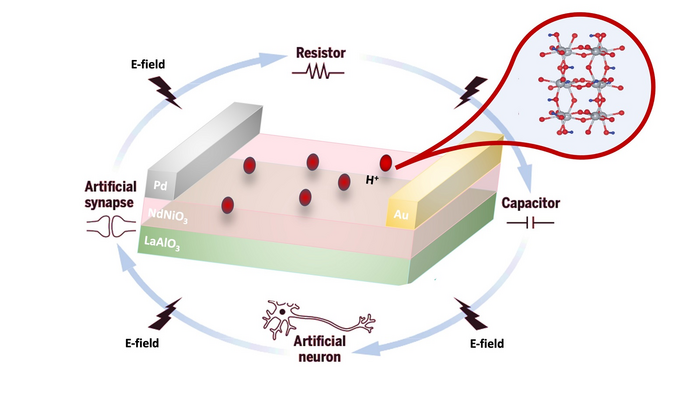
Hydrogen ions in the nickelate enable one of four functions at different voltages (applied by platinum and gold electrodes at the top). The functions are artificial synapse, artificial neuron, capacitor, and resistor. The capacitor stores and releases current; the resistor blocks it. Credit: Argonne National Laboratory
The key material in the new device consists of neodymium, nickel, and oxygen and is referred to as perovskite nickelate (NdNiO3). The team infused this material with hydrogen and attached electrodes to it that allow electrical pulses to be applied at different voltages.
“How much hydrogen is in the nickelate, and where it is, changes the electronic properties,” Sankaranarayanan said. “And we can change its location and concentration with different electrical pulses.”
“This material has a many-layered personality,” added Hua Zhou, a paper co-author and Argonne physicist. “It has the two usual functions of everyday electronics — the turning on and blocking of electrical current as well as the storing and release of electricity. What’s really new and striking is the addition of two functions similar to the separate behavior of synapses and neurons in the brain.” A neuron is a single nerve cell that connects with other nerve cells via synapses. Neurons initiate sensing of the external world.
For its contribution, the Argonne team carried out the computational and experimental characterization of what happens in the nickelate device under different voltages. To that end, they relied on DOE Office of Science user facilities at Argonne: the Advanced Photon Source, Argonne Leadership Computing Facility, and Center for Nanoscale Materials.
The experimental results demonstrated that simply altering the voltage controls the movement of hydrogen ions within the nickelate. A certain voltage concentrates hydrogen at the nickelate center, spawning neuron-like behavior. A different voltage shuttles that hydrogen out of the center, yielding synapse-like behavior. At still different voltages, the resulting locations and concentration of the hydrogen elicit the on-off currents of computer chips.
“Our computations revealing this mechanism at the atomic scale were super intensive,” said Argonne scientist Sukriti Manna. The team relied upon the computational horsepower of not only the Argonne Leadership Computing Facility but also the National Energy Research Scientific Computing Center, a DOE Office of Science user facility at Lawrence Berkeley National Laboratory.
Confirmation of the mechanism came, in part, from experiments at beamline 33-ID-D of the Advanced Photon Source.
“Over the years we have had a very productive partnership with the Purdue group,” Zhou said. “Here, the team determined exactly how atoms arrange within the nickelate under different voltages. Especially important was tracking the material’s response at the atomic scale to the movement of hydrogen.”
With the team’s nickelate device, scientists will work to create a network of artificial neurons and synapses that could learn and modify from experience. This network would grow or shrink as it is presented with new information and would thus be able to work with extreme energy efficiency. And that energy efficiency translates into lower operational costs.
Brain-inspired microelectronics with the team’s device as a building block could have a bright future. This is especially so because the device can be made at room temperature by techniques compatible with semiconductor industry practices.
Argonne-related work was funded by the DOE Office of Basic Energy Sciences, as well as the Air Force Office of Scientific Research and National Science Foundation.
Reference: “Reconfigurable perovskite nickelate electronics for artificial intelligence” by Hai-Tian Zhang, Tae Joon Park, A. N. M. Nafiul Islam, Dat S. J. Tran, Sukriti Manna, Qi Wang, Sandip Mondal, Haoming Yu, Suvo Banik, Shaobo Cheng, Hua Zhou, Sampath Gamage, Sayantan Mahapatra, Yimei Zhu, Yohannes Abate, Nan Jiang, Subramanian K. R. S. Sankaranarayanan, Abhronil Sengupta, Christof Teuscher and Shriram Ramanathan, 3 February 2022, Science.
DOI: 10.1126/science.abj7943
The new technology could allow computers to do complicated tasks more quickly and accurately while using much less energy.
What if a computer could learn to rewire its circuits based on the information it receives?
A multi-institutional collaboration, which includes the U.S. Department of Energy’s (DOE) Argonne National Laboratory, has created a material that can be used to create computer chips that can do just that. It achieves this by using so-called “neuromorphic” circuitry and computer architecture to replicate brain functions. Purdue University professor Shriram Ramanathan led the team.
“Human brains can actually change as a result of learning new things,” said Subramanian Sankaranarayanan, a paper co-author with a joint appointment at Argonne and the University of Illinois Chicago. “We have now created a device for machines to reconfigure their circuits in a brain-like way.”
With this capability, artificial intelligence-based computers might do difficult jobs more quickly and accurately while using a lot less energy. One example is analyzing complicated medical images. Autonomous cars and robots in space that might rewire their circuits depending on experience are a more futuristic example.
Hydrogen ions in the nickelate enable one of four functions at different voltages (applied by platinum and gold electrodes at the top). The functions are artificial synapse, artificial neuron, capacitor, and resistor. The capacitor stores and releases current; the resistor blocks it. Credit: Argonne National Laboratory
Hydrogen ions in the nickelate enable one of four functions at different voltages (applied by platinum and gold electrodes at the top). The functions are artificial synapse, artificial neuron, capacitor, and resistor. The capacitor stores and releases current; the resistor blocks it. Credit: Argonne National Laboratory
The key material in the new device consists of neodymium, nickel, and oxygen and is referred to as perovskite nickelate (NdNiO3). The team infused this material with hydrogen and attached electrodes to it that allow electrical pulses to be applied at different voltages.
“How much hydrogen is in the nickelate, and where it is, changes the electronic properties,” Sankaranarayanan said. “And we can change its location and concentration with different electrical pulses.”
“This material has a many-layered personality,” added Hua Zhou, a paper co-author and Argonne physicist. “It has the two usual functions of everyday electronics — the turning on and blocking of electrical current as well as the storing and release of electricity. What’s really new and striking is the addition of two functions similar to the separate behavior of synapses and neurons in the brain.” A neuron is a single nerve cell that connects with other nerve cells via synapses. Neurons initiate sensing of the external world.
For its contribution, the Argonne team carried out the computational and experimental characterization of what happens in the nickelate device under different voltages. To that end, they relied on DOE Office of Science user facilities at Argonne: the Advanced Photon Source, Argonne Leadership Computing Facility, and Center for Nanoscale Materials.
The experimental results demonstrated that simply altering the voltage controls the movement of hydrogen ions within the nickelate. A certain voltage concentrates hydrogen at the nickelate center, spawning neuron-like behavior. A different voltage shuttles that hydrogen out of the center, yielding synapse-like behavior. At still different voltages, the resulting locations and concentration of the hydrogen elicit the on-off currents of computer chips.
“Our computations revealing this mechanism at the atomic scale were super intensive,” said Argonne scientist Sukriti Manna. The team relied upon the computational horsepower of not only the Argonne Leadership Computing Facility but also the National Energy Research Scientific Computing Center, a DOE Office of Science user facility at Lawrence Berkeley National Laboratory.
Confirmation of the mechanism came, in part, from experiments at beamline 33-ID-D of the Advanced Photon Source.
“Over the years we have had a very productive partnership with the Purdue group,” Zhou said. “Here, the team determined exactly how atoms arrange within the nickelate under different voltages. Especially important was tracking the material’s response at the atomic scale to the movement of hydrogen.”
With the team’s nickelate device, scientists will work to create a network of artificial neurons and synapses that could learn and modify from experience. This network would grow or shrink as it is presented with new information and would thus be able to work with extreme energy efficiency. And that energy efficiency translates into lower operational costs.
Brain-inspired microelectronics with the team’s device as a building block could have a bright future. This is especially so because the device can be made at room temperature by techniques compatible with semiconductor industry practices.
Argonne-related work was funded by the DOE Office of Basic Energy Sciences, as well as the Air Force Office of Scientific Research and National Science Foundation.
Reference: “Reconfigurable perovskite nickelate electronics for artificial intelligence” by Hai-Tian Zhang, Tae Joon Park, A. N. M. Nafiul Islam, Dat S. J. Tran, Sukriti Manna, Qi Wang, Sandip Mondal, Haoming Yu, Suvo Banik, Shaobo Cheng, Hua Zhou, Sampath Gamage, Sayantan Mahapatra, Yimei Zhu, Yohannes Abate, Nan Jiang, Subramanian K. R. S. Sankaranarayanan, Abhronil Sengupta, Christof Teuscher and Shriram Ramanathan, 3 February 2022, Science.
DOI: 10.1126/science.abj7943
Space
Quest to Reveal Fundamental Secrets of the Universe Driven by Curiosity and Technology
‘Jenga Chemistry’ Creates Superconductivity in a Nickel Oxide Material
New Electrolyte Improves Cycle Life of Next-Generation Lithium-Ion Batteries
Human Brain Signals Recorded in Record-Breaking Resolution by New Sensor Grids
New Quantum Loop Allows Testing of Spooky Action at a Great Distance
Testing Our Fundamental Understanding of the Universe: Muon G-2 Experiment Hints at Mysterious New Physics
New Electrocatalyst Turns Carbon Dioxide Into Liquid Fuel
In the Fight Against Coronavirus, Supercomputers & Giant Accelerators Lend a Hand
What will happen when computers design and build the next generation of computers? That time is coming. We need to prepare.
Email address is optional. If provided, your email will not be published or shared.
SciTechDaily: Home of the best science and technology news since 1998. Keep up with the latest scitech news via email or social media.


July 3, 2022
Fixing Shoulder Pain: Harvard Scientists Develop a Method To Restore Damaged Tendons and Muscles
The new complex tissue platform can restore damaged rotator cuffs The typical office worker often has soreness throughout their body as a result of their…
The new complex tissue platform can restore damaged rotator cuffs The typical office worker often has soreness throughout their body as a result of their…
July 3, 2022
Say Goodbye to Binge Eating: Signal Pathway in Brain That Controls Food Intake Discovered
July 3, 2022
Help NASA Solve a Fundamental Martian Mystery
July 3, 2022
How Cockroaches Survived the Asteroid That Led to the Extinction of Dinosaurs
July 3, 2022
Physicists Create Continuous Time Crystal for the First Time
July 2, 2022
AI Algorithm Predicts Future Crimes One Week in Advance With 90% Accuracy
July 2, 2022
Harvard Developed AI Identifies the Shortest Path to Human Happiness
July 2, 2022
The Chemistry of Cooking Over an Open Flame: What Makes Smoky, Charred Barbecue Taste So Good?
Copyright © 1998 – 2022 SciTechDaily. All Rights Reserved.