
How Fixed-Wireless Technologies Compare to Fiber | Benton Institute for Broadband & Society – Benton Foundation

Subscribe
Subscribe
Friday, June 24, 2022
You’re reading the Benton Institute for Broadband & Society’s Weekly Digest, a recap of the biggest (or most overlooked) broadband stories of the week. The digest is delivered via e-mail each Friday.
This week’s guest writer is CTC Technology & Energy’s Andrew Afflerbach, the author of Fixed Wireless Technologies and Their Suitability for Broadband Delivery
Round-Up for the Week of June 20-24, 2022
As state and local governments and their partners plan to invest billions of dollars in federal funding to build broadband infrastructure, choosing the best technology will have significant long-term implications. Federal policymakers have addressed this subject to some degree: For example, the Broadband Equity, Access, and Deployment (BEAD) Program’s notice of funding opportunity (NOFO) preferences fiber over fixed wireless.
To aid state and local policymakers, CTC Technology & Energy conducted an engineering analysis of fixed-wireless technologies and their suitability for delivering broadband service in various environments. The resulting report, Fixed Wireless Technologies and Their Suitability for Broadband Delivery, addresses a range of critical technology and cost considerations related to fixed-wireless networks—and, as a point of comparison, to fiber-to-the-premises networks. The report seeks to do the following: 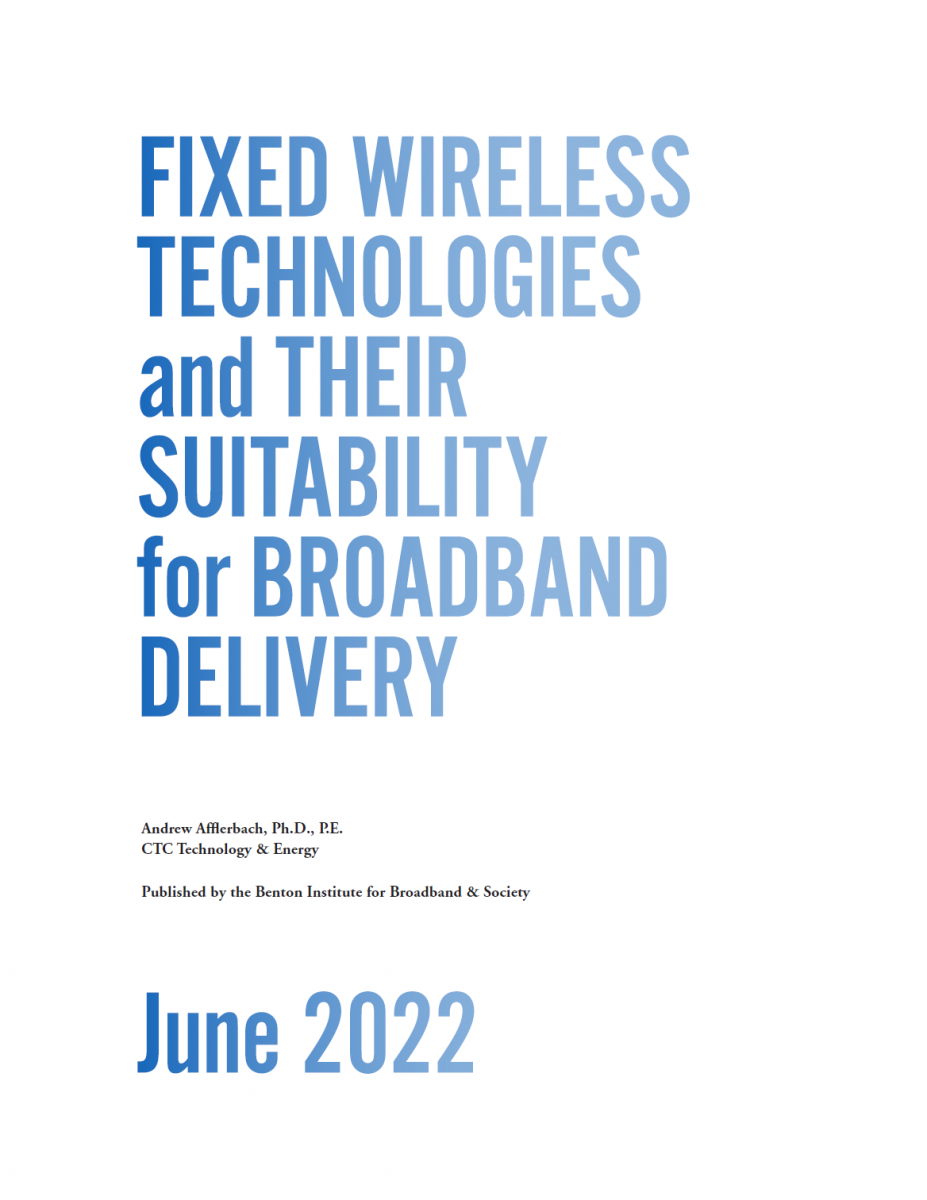
At a high level, the report concludes the following:
To further illustrate the relative strengths and weaknesses of fixed-wireless technologies, this report presents an analysis of capital and operating costs for a candidate fixed wireless network as compared to a candidate fiber-optic network in the same real-world settings. The candidate networks were each designed to deliver complete coverage to unserved residential locations.
While the cost analysis illustrates that fiber’s upfront capital costs are higher than those of fixed wireless in many circumstances, the total cost of ownership over 30 years is comparable for fiber and fixed wireless.
The analysis of fixed wireless and fiber-to-the-premises network designs across four types of rural deployment scenarios identified the following key cost factors:
Given the above analysis, fiber offers the greater long-term value as compared to fixed-wireless technologies because of fiber’s long life, capabilities, scalability, and flexibility. In the event that a state funds technologies other than fiber, such as in circumstances where the capital cost to build fiber is cost-prohibitive or the need for service cannot wait for fiber construction, the state should take steps to protect its investment—such as by requiring grantees to guarantee the long-term maintenance and operations of the fixed wireless network. This could be accomplished by requiring a 20-year performance and budget roadmap, and a viable strategy for full service where line-of-sight is a challenge.
Fixed Wireless Technologies and Their Suitability for Broadband Delivery was commissioned by the Communications Workers of America, prepared by CTC Technology & Energy, and published by the Benton Institute for Broadband & Society.
Andrew Afflerbach, Ph.D., P.E., is CEO and CTO of CTC Technology & Energy. He specializes in planning, designing, and overseeing the implementation of broadband communications networks. Over the course of more than 25 years in the field, Andrew has developed broadband engineering strategy and specifications for dozens of fiber and wireless networks in both rural and urban areas, ranging in size from small towns to large states to nation-wide efforts like the New Zealand fiber-to-the-premises initiative.
Jun 28—How 5G Can Spur Climate Tech Innovation (Information Technology & Innovation Foundation)
Jun 28—Overview of IIJA NOFOs: BEAD, DEA and Middle Mile Programs Webinar (Merit)
Jun 28—Baltimore’s Broadband Movement: A Virtual Event with Community Leadership (Next Century Cities)
Jun 28—Disability Advisory Committee Meeting (FCC)
Jun 28—Connections: How Broadband Investment Influences the U.S. Economy (Network:On)
Jun 29—What Will Be the Impact of the UK’s Online Safety Bill on Encryption and Anonymity Online? (Center for Data Innovation)
Jun 29—Webinar on Using the Broadband Data Collection System (FCC)
Jul 14—July 2022 Open Federal Communications Commission Meeting (FCC)
The Benton Institute for Broadband & Society is a non-profit organization dedicated to ensuring that all people in the U.S. have access to competitive, High-Performance Broadband regardless of where they live or who they are. We believe communication policy – rooted in the values of access, equity, and diversity – has the power to deliver new opportunities and strengthen communities.
© Benton Institute for Broadband & Society 2022. Redistribution of this email publication – both internally and externally – is encouraged if it includes this copyright statement.
For subscribe/unsubscribe info, please email headlinesATbentonDOTorg
Kevin Taglang
Executive Editor, Communications-related Headlines
Benton Institute
for Broadband & Society
1041 Ridge Rd, Unit 214
Wilmette, IL 60091
847-328-3040
headlines AT benton DOT org
Share this edition:



Broadband Delivers Opportunities and Strengthens Communities
CONTACT
Benton Institute
for Broadband & Society
1041 Ridge Rd, Unit 214
Wilmette, IL 60091
847-328-3040
Contact Us
© 1994-2022 Benton Institute for Broadband & Society. All Rights Reserved.