
Paying Tribute to Computer Science Pioneer Frederick Brooks, Jr. – IEEE Spectrum

The December 2022 issue of IEEE Spectrum is here!
IEEE websites place cookies on your device to give you the best user experience. By using our websites, you agree to the placement of these cookies. To learn more, read our Privacy Policy.
He helped develop the IBM System/360 and its operating system
Frederick P. Brooks Jr., a prolific computer scientist and longtime professor of computer science, died on 17 November at the age of 91.
While working as a project manager at IBM in the 1960s, the IEEE Life Fellow led the development of the System/360 computer family. It was the first vertically compatible family of mainframe computers. Brooks also developed IBM’s OS/360, the world’s largest software project at the time. He is credited with coining the term computer architecture, which is used to describe how hardware and software are organized to make up a computer system and the operations which guide its function. He wrote The Mythical Man-Month, a book of essays published in 1975 that detailed lessons he learned from challenges he faced while developing the OS/360.
Brooks left IBM in 1964 to found the University of North Carolina’s computer science department in Chapel Hill.
Although he retired from teaching in 2013, Brooks was still active in the university’s research program in virtual environmentsand scientific visualization until 2020.
After earning a bachelor’s degree in physics in 1953 from Duke University, in Durham, N.C., Brooks received a Ph.D. in applied mathematics in 1956 from Harvard. He completed his dissertation—the development of a computer that could do payrolls—under the supervision of computer pioneer Howard Aiken, who had designed IBM’s Harvard Mark I computer.
Brooks joined IBM in Poughkeepsie, N.Y., in 1957. His first assignment was working on the IBM 7030. Known as Stretch, it was the first transistorized supercomputer. Although commercially unsuccessful, Stretch inspired technologies used in inventions such as instruction pipelining and memory interleaving. Brooks also designed Harvest, IBM’s 7030 character-processing auxiliary processor.
His next project was the IBM 8000 series of computers. In 1961 IBM deemed the project a failure and terminated it.
That same year, Brooks was tasked with leading the development of a family of general-purpose systems for both commercial and scientific applications. Before the release of IBM System/360, computer systems were incompatible with each other, even if they were developed by the same manufacturer. Software and peripherals from old systems would not work with new ones, making it costly for customers to upgrade their hardware, according to an IBM article about the technology.
The System/360, released in 1964, contained six processor models with 40 peripherals. The line was named the 360 because it addressed the needs of all types of customers. Within five years of its release, more than 3,000 units were sold, and it generated more than US $100 billion in revenue through the mid-1980s, according to the IBM article.
The system also popularized the concept of a computer upgrade and introduced the industry standard of the 8-bit byte, for which Brooks was responsible. The 8-bit byte enabled a computer to run software that produced both upper- and lower-case characters.
Due to the success of the system, Brooks was appointed lead developer of the 360 family of operating systems. The OS/360 was the forerunner of Microsoft’s Windows, Apple’s iOS, and Google’s Android software systems.
When Brooks joined the University of North Carolina, he was its first professor of computer science. He served as department chair for 20 years, and he taught and conducted research at the university for more than 50 years. His research focused mainly on interactive computer graphics and virtual reality.
“Many in the department and beyond appreciated the fact that in a world full of academic competition and research silos, Brooks fostered a departmental culture of open collaboration and respect,” says Mary C. Whitton, a retired University of North Carolina research professor. The IEEE life senior member worked closely with Brooks for more than two decades.
Brooks was honored multiple times for his pioneering work. He was awarded the 1993 IEEE John von Neumann Medal and received two awards from the IEEE Computer Society: the 1980 Women of ENIAC Computer Pioneer Award and the 1970 W. Wallace McDowell Award.
He received the 1999 A.M. Turing Award from the Association for Computing Machinery, known as the Nobel Prize of computing. He was honored for “landmark contributions to computer architecture, operating systems, and software engineering.”
Brooks also received the 1985 U.S. National Medal of Technology alongside his IBM colleagues Bob Evans and Erich Bloch for the development of System/360. The award was given to them by U.S. President Ronald Reagan.
Joanna Goodrich is the associate editor of The Institute, covering the work and accomplishments of IEEE members and IEEE and technology-related events. She has a master's degree in health communications from Rutgers University, in New Brunswick, N.J.
LTA Research’s Pathfinder 1 aims to solve humanitarian-relief and supply-chain bottlenecks
LTA Research staff maneuver Pathfinder 1 while the airship is under construction at the company’s Moffett Field facility, near San Francisco.
At Moffett Field in Mountain View, Calif., Lighter Than Air (LTA) Research is floating a new approach to a technology that saw its rise and fall a century ago: airships. Although airships have long since been supplanted by planes, LTA, which was founded in 2015 by CEO Alan Weston, believes that through a combination of new materials, better construction techniques, and technological advancements, airships are poised to—not reclaim the skies, certainly—but find a new niche.
Although airships never died off entirely—the Goodyear blimps, familiar to sports fans, are proof of that—the industry was already in decline by 1937, the year of the Hindenburg disaster. By the end of World War II, airships couldn’t compete with the speed airplanes offered, and they required larger crews. Today, what airships still linger serve primarily for advertising and sightseeing.
LTA’s Pathfinder 1 carries bigger dreams than hovering over a sports stadium, however. The company sees a natural fit for airships in humanitarian and relief missions. Airships can stay aloft for long periods of time, in case ground conditions aren’t ideal, have a long range, and carry significant payloads, according to Carl Taussig, LTA’s chief technical officer.
Pathfinder’s cigar-shaped envelope is just over 120 meters in length and 20 meters in diameter. While that dwarfs Goodyear’s current, 75-meter Wingfoot One, it’s still only half the length of the Hindenburg. LTA expects Pathfinder 1 to carry approximately 4 tonnes of cargo, in addition to its crew, water ballast, and fuel. The airship will have a top speed of 65 knots, or about 120 kilometers per hour—on par with the Hindenburg—with a sustained cruise speed of 35 to 40 knots (65 to 75 km/h).
It may not seem much of an advance to be building an airship that flies no faster than the Hindenburg. But Pathfinder 1 carries a lot of new tech that LTA is betting will prove key to an airship resurgence.
For one, airships used to be constructed around riveted aluminum girders, which provided the highest strength-to-weight ratio available at the time. Instead, LTA will be using carbon-fiber tubes attached to titanium hubs. As a result, Pathfinder 1’s primary structure will be both stronger and lighter.
Pathfinder 1’s outer covering is also a step up from past generations. Airships like the 1930s’ Graf Zeppelin had coverings made out of doped cotton canvas. The dope painted on the fabric increased its strength and resiliency. But canvas is still canvas. LTA has instead built its outer coverings out of a three-layer laminate of synthetics. The outermost layer is DuPont’s Tedlar, which is a polyvinyl fluoride. The middle layer is a loose weave of fire-retardant aramid fibers. The inner layer is polyester. “It’s very similar to what’s used in a lot of racing sailboats,” says Taussig. “We needed to modify that material to make it fire resistant and change a little bit about its structural performance.” 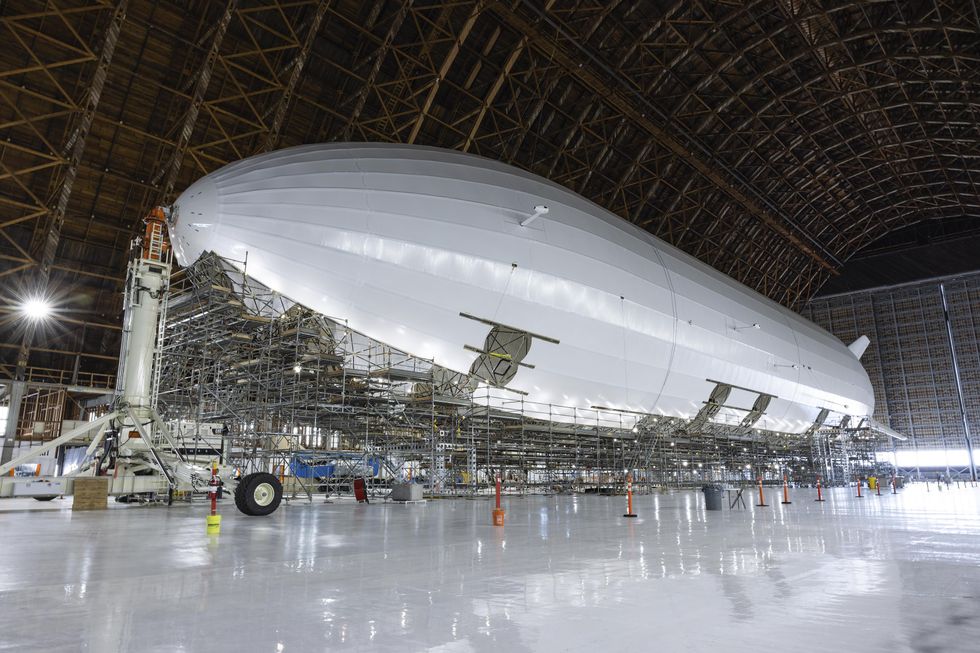 LTA Research
But neither the materials science nor the manufacturing advances will take primary credit for LTA’s looked-for success, according to Taussig—instead, it’s the introduction of electronics. “Everything’s electric on Pathfinder,” he says. “All the actuation, all the propulsion, all the actual power is all electrically generated. It’s a fully electric fly-by-wire aircraft, which is not something that was possible 80 years ago.” Pathfinder 1 has 12 electric motors for propulsion, as well as four tail fins with steering rudders controlled by its fly-by-wire system. (During initial test flights, the airship will be powered by two reciprocating aircraft engines).
There’s one other piece of equipment making an appearance on Pathfinder 1 that wasn’t available 80 years ago: lidar. Installed at the top of each of Pathfinder 1’s helium gas cells is an automotive-grade lidar. “The lidar can give us a point cloud showing the entire internal hull of that gas cell,” says Taussig, which can then be used to determine the gas cell’s volume accurately. In flight, the airship’s pilots can use that information, as well as data about the helium’s purity, pressure, and temperature, to better keep the craft pitched properly and to avoid extra stress on the internal structure during flight.
Although LTA’s initial focus is on humanitarian applications, there are other areas where airships might shine one day. “An airship is kind of a ‘tweener,’ in between sea cargo and air freight,” says Taussig. Being fully electric, Pathfinder 1 is also greener than traditional air- or sea-freight options.
After completing Pathfinder 1’s construction late in 2022, LTA plans to conduct a series of ground tests on each of the airship’s systems in the first part of 2023. Once the team is satisfied with those tests, they’ll move to tethered flight tests and finally untethered flight tests over San Francisco’s South Bay later in the year.
The company will also construct an approximately 180-meter-long airship, Pathfinder 3 at its Akron Airdock facility in Ohio. Pathfinder 3 won’t be ready to fly in 2023, but its development shows LTA’s aspirations for an airship renaissance is more than just hot air.