
What Novel Technologies Can Generate Energy from Our Bodies? – AZoM

We use cookies to enhance your experience. By continuing to browse this site you agree to our use of cookies. More info.
Energy harvesting devices are specially utilized to capture energy from the user’s body and are being researched extensively. Novel research analysis published in the journal Energies focuses on the most important new wearables and gadgets for capturing energy from the human body.
Study: New Wearable Technologies and Devices to Efficiently Scavenge Energy from the Human Body: State of the Art and Future Trends. Image Credit: Login/Shutterstock.com
Every digital item requires power to function, particularly wearable ones that should have a prolonged battery capacity. Wearable technology can be used to manage physiological indicators, including body temperature, pulse rate, respiratory rate, etc., instantaneously, as well as for post-surgery rehabilitation.
Multifunctional energy harvesters are a creative way for users to avoid unpleasant invasive devices. It is possible to collect and store energy from several energy sources in the human body utilizing these novel portable gadgets.
Based on an operational mode, energy harvester systems include triboelectric gadgets, piezoelectric equipment, thermoelectric, and solar textiles, among various others.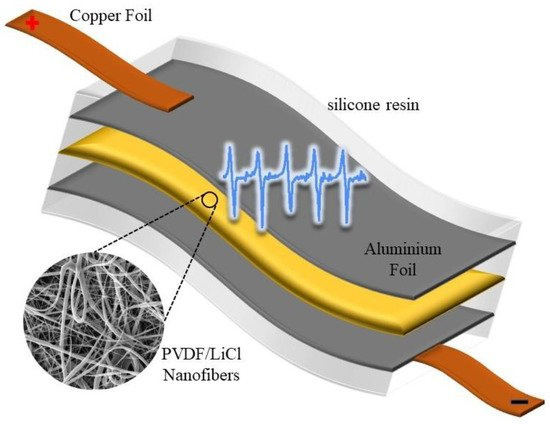
Internal structure of the nanogenerator device based on the PVDF/LiCl layer. Image Credit: Fazio, R.D. et al., Energies
Most commonly, it consists of a piezoelectric polymer that has the special ability to create a potential difference whenever stresses applied over its surface cause a deformation. Hence, an electric current is produced whenever any stress is applied or deformation occurs.
These substances offer a compact build, conformity to the human body, and are biocompatible. All these advantages have played a major role in the development of novel stretchable and high-performance wearable piezoelectric materials.
Additionally, researchers have advocated for the use of a ferroelectric polymeric nanostructure in the fabrication of fabric-WPEH (Wearable Piezoelectric Energy Harvester), which allows for the practical application of transducers to clothing through a heat press.
The triboelectric phenomenon turns any motion or kinetic energy into an electric current by bringing together two materials with different electron enthalpies, resulting in a charge density over the exterior with oppositely charged particles spread over the two materials. This potential difference leads to the generation of an electric current.
To increase device responsiveness, the electrode configuration must be adjusted. Furthermore, the sensing structure is improved by improving the electromechanical connection with the application situations, hence boosting its effectiveness, reducing reaction time, and substantially achieving real-time signal capturing.
Researchers have created a novel fabric-based TENG device that consists of knitted electrodes and woven bands of positive and negative triboelectric material. Under a 2 Hz motorized generator and a 50 M load, it can provide 62.9 V open-circuit voltage, 1.77 A short-circuit current, and 34.8 W power.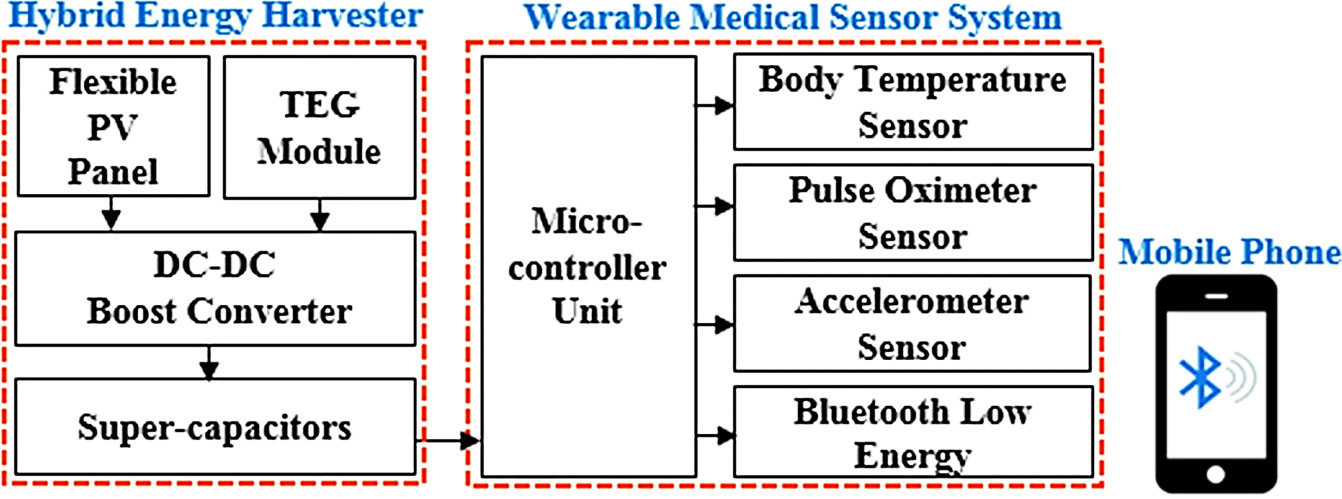
Architecture of the multi-source energy harvesting system to feed the sensor system. Image Credit: Fazio, R.D. et al., Energies
A thermoelectric generator (TEG) utilizes the Seeback effect to efficiently produce energy. The temperature difference between two different semiconductors is utilized to generate electric current during the Seeback phenomena. Semiconductor bands and P-N junctions make up the TEG which generates a potential that is converted into electrical energy.
Obtaining a 1% efficiency is also challenging due to the practical limits established by wearability standards. To maximize efficacy and decrease wearable system energy demands, it is more practical to utilize a TEG on a restricted body region.
At the moment, the materials science community is particularly vested in developing flexible electronics based on conjugated polymers. As thermoelectric materials, several altered conjugated polymer systems have been explored. They may be converted into textiles by a variety of methods, including depositing onto pre-made textiles or weaving into mixed fibers.
Sunlight is an abundant natural power source that can be captured by photovoltaic cells. Flexible-wearable photovoltaics provide feasible alternatives to traditional power generation sources due to their outstanding tensile characteristics, high power-to-weight ratios, and low-cost production procedures. These are projected as the future of handheld power harvesting wearables that can be embedded into almost any substrate.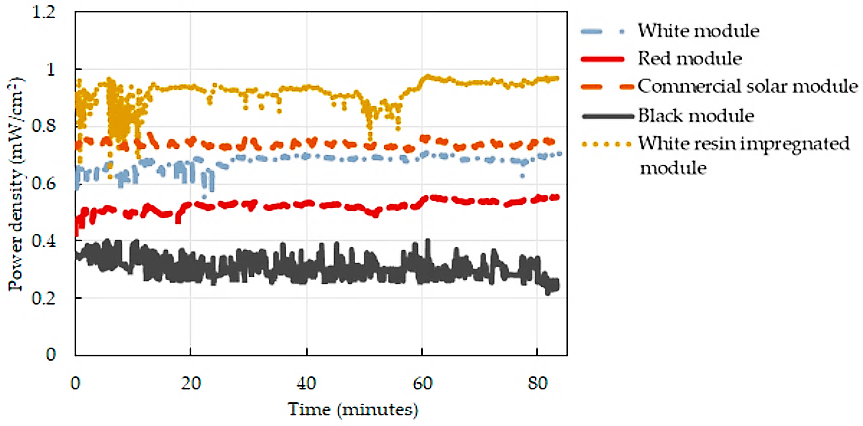
Power densities of five solar modules (four solar harvesting textiles and one flexible commercial solar cell) monitored for 85 min. Image Credit: Fazio, R.D. et al., Energies
Epidermal biofuel cells (BFCs) have piqued the curiosity of researchers in recent times. Epidermal (skin-based) enzymatic BFCs dependent on sweating provide an effective non-invasive energy harvesting approach, albeit they can only create and transmit energy when the user perspires. Variable concentrations of lactate biofuel and perspiration restrict consistent energy output as a result of inconsistent human sweating.
In short, energy recovery devices are the primary research topic for overcoming battery constraints such as decreased lifetime and power density. Energy harvesting components that are properly designed and optimized may scavenge power from the human body to replenish the batteries, increasing the device’s autonomy.
Fazio, R.D. et al. (2022). New Wearable Technologies and Devices to Efficiently Scavenge Energy from the Human Body: State of the Art and Future Trends. Energies. 15. 6639. Available at: https://www.mdpi.com/1996-1073/15/18/6639
Disclaimer: The views expressed here are those of the author expressed in their private capacity and do not necessarily represent the views of AZoM.com Limited T/A AZoNetwork the owner and operator of this website. This disclaimer forms part of the Terms and conditions of use of this website.
Written by
Ibtisam graduated from the Institute of Space Technology, Islamabad with a B.S. in Aerospace Engineering. During his academic career, he has worked on several research projects and has successfully managed several co-curricular events such as the International World Space Week and the International Conference on Aerospace Engineering. Having won an English prose competition during his undergraduate degree, Ibtisam has always been keenly interested in research, writing, and editing. Soon after his graduation, he joined AzoNetwork as a freelancer to sharpen his skills. Ibtisam loves to travel, especially visiting the countryside. He has always been a sports fan and loves to watch tennis, soccer, and cricket. Born in Pakistan, Ibtisam one day hopes to travel all over the world.
Please use one of the following formats to cite this article in your essay, paper or report:
APA
Abbasi, Ibtisam. (2022, September 13). What Novel Technologies Can Generate Energy from Our Bodies?. AZoM. Retrieved on September 16, 2022 from https://www.azom.com/news.aspx?newsID=59997.
MLA
Abbasi, Ibtisam. "What Novel Technologies Can Generate Energy from Our Bodies?". AZoM. 16 September 2022. <https://www.azom.com/news.aspx?newsID=59997>.
Chicago
Abbasi, Ibtisam. "What Novel Technologies Can Generate Energy from Our Bodies?". AZoM. https://www.azom.com/news.aspx?newsID=59997. (accessed September 16, 2022).
Harvard
Abbasi, Ibtisam. 2022. What Novel Technologies Can Generate Energy from Our Bodies?. AZoM, viewed 16 September 2022, https://www.azom.com/news.aspx?newsID=59997.
Do you have a review, update or anything you would like to add to this news story?
Cancel reply to comment
Dave Cist, Roger Roberts and Rob Sommerfeldt
In this interview, AZoM talks to Dave Cist, Roger Roberts, and Rob Sommerfeldt from GSSI about the Pavescan RDM, MDM, and their ground penetrating radar (GPR) capabilities. They also discuss how this can aid the asphalt production and laying processes.
Cameron Day
Following the Advanced Materials Show 2022, AZoM spoke with Cameron Day from William Blythe about the broad scope of the company and its goals for the future.
Andrew Terentjev
At the Advanced Materials Show 2022, AZoM caught up with the CEO of Cambridge Smart Plastics, Andrew Terentjev. In this interview, we discuss the company's novel technologies and how they could revolutionize how we think about plastics.
The CVD Diamond from Element Six is a high purity synthetic diamond that is used for electronic thermal management.
Discover the CNR4 Net Radiometer, a powerful tool that can measure the energy balance between short-wave and long-wave Far Infrared radiation.
The Powder Rheology Accessory expands TA Instruments’ Discovery Hybrid Rheometer (DHR) capabilities to powders, enabling characterization of behaviors during storage, dispensing, processing, and end use.
This article provides an end-of-life assessment of lithium-ion batteries, focusing on the recycling of an ever-growing amount of spent Li-Ion batteries in order to work toward a sustainable and circular approach to battery use and reuse.
Corrosion is the degradation of an alloy caused by its exposure to the environment. Corrosion deterioration of metallic alloys exposed to the atmosphere or other adverse conditions is prevented using a variety of techniques.
Due to the ever-increasing demand for energy, the demand for nuclear fuel has also increased, which has further created a significant increase in the requirement for post-irradiation examination (PIE) techniques.
AZoM.com – An AZoNetwork Site
Owned and operated by AZoNetwork, © 2000-2022